The SAS Assault at Princes Gate
David Shepherd
CBE OBE FRSA FGRA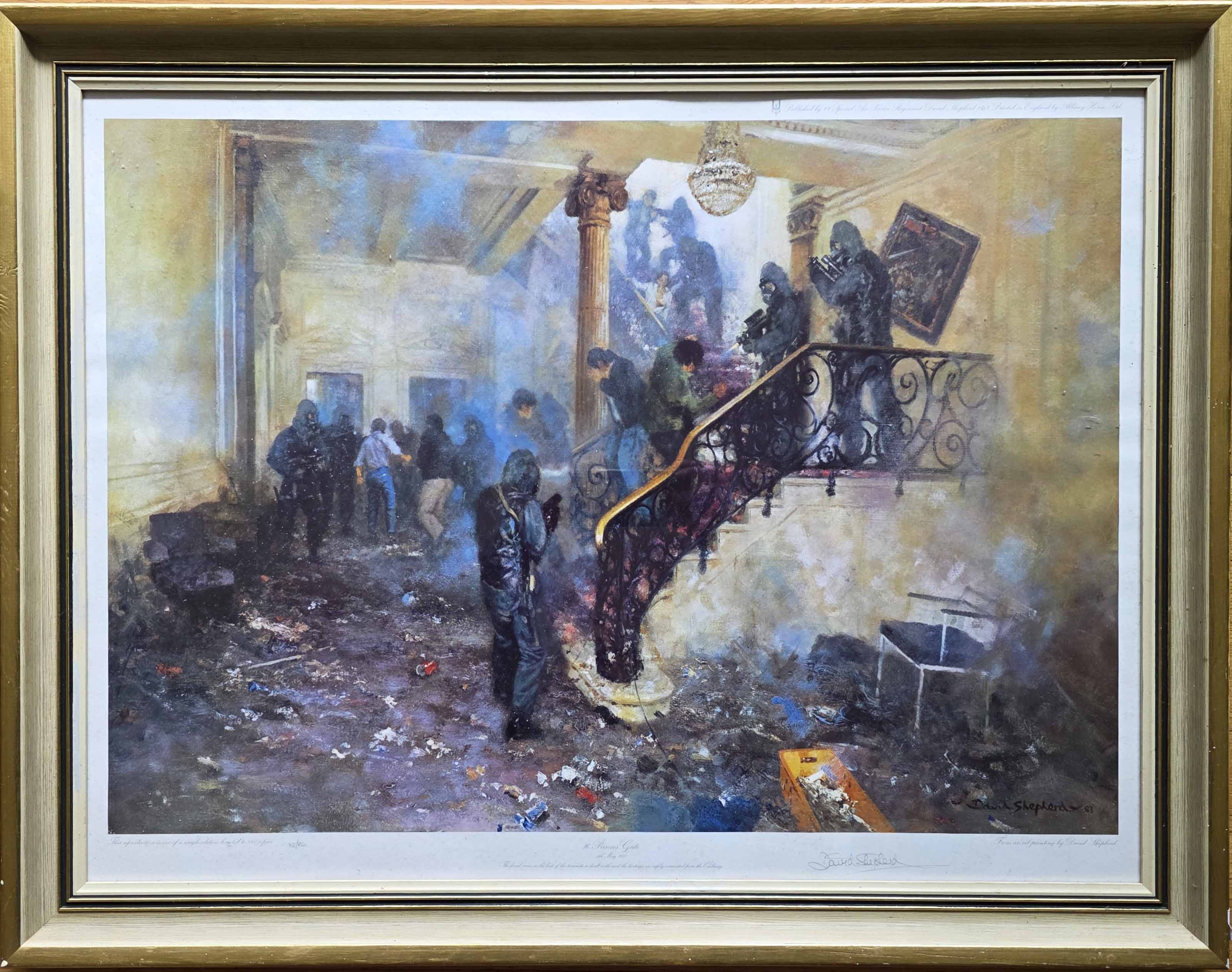
16 Princes Gate - 5th May 1980
(The Final Scene as the Last of the Terrorists are Dealt with and the Hostages are Safely Evacuated from the Embassy)
Limited edition print
by David Shepherd
Operation Nimrod
The SAS Assault at Princes Gate
London, 1980
By Thomas B. Hunter
Reprinted by permission of Special Operations
Journal (c. 1997)
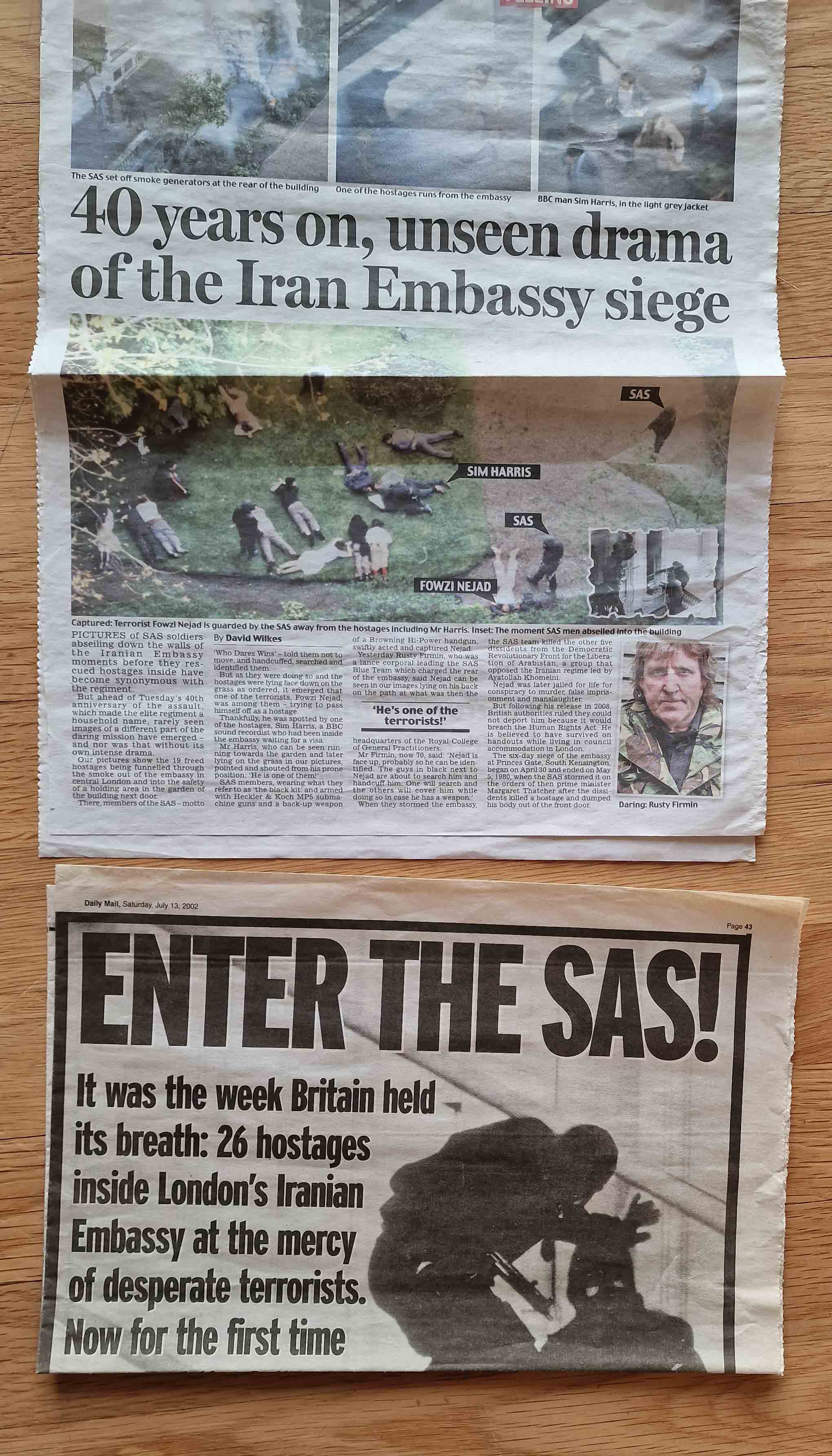
At 11:30 a.m. on 30 April 1980, six armed revolutionaries
of the Democratic Revolutionary Movement for the Liberation of Arabistan
(DRMLA) burst into the Iranian Embassy at No. 16 Princes Gate, London firing
weapons and taking twenty-six hostages. They brought with them a small
but deadly arsenal, including SMG and Browning 9mm pistols (loaded with
hollow-point ammunition), a .38 revolver, and Russian-made hand grenades.
The gunmen, it would soon be revealed, were members of an Iraqi-backed,
anti-Khomeni organization whose goal was regional autonomy for Arabistan,
an oil-rich province in southwest Iran. Oan, the leader of the terrorists,
promptly made the following announcement: "One: we demand our human
and legitimate rights. Two: we demand freedom, autonomy and recognition
of the Arabistan people. Three: we demand the release of ninety-one Arab
prisoners in Arabistan." Then came the threat. "If all the demands
are not met by noon on Thursday, May 1, the Embassy and all the hostages
will be blown up."
Unbeknown to the terrorists, Police Constable Trevor Lock who was present in his capacity with the Diplomatic Protection Group at the embassy during the takeover, managed to activate a hidden alert device on his lapel. Thus notified, the Metropolitan Police's C13 Antiterrorist Squad was dispatched to the scene, along with electronic intelligence specialists from C7 (Scotland Yard's Technical Support Branch) and other personnel. These units joined police sharpshooters who had taken up sniper/countersniper positions and were providing on-site intelligence.
At the same time, at Hereford, headquarters of the 22
Special Air Service Regiment (SAS), a call came in from a former member
of the unit's D Squadron, then working as a dog handler for the Metropolitan
Police. He notified them that a situation was developing that might require
the attention of the Special Projects (SP) Team of the SAS Counter Revolutionary
Warfare Wing (CRW), the on-call SAS unit tasked specifically with responding
to developing terrorist incidents. This advance notice - a result of an
informal intelligence network comprised by just such former troopers -
provided the SAS with valuable lead-time. Members of B Squadron's Pagoda
Troop, the SP alert team, were taking part in regular close-quarters battle
(CQB) drills in the regiment's 'Killing House' when their beepers went
off in unison. The team hastily departed Hereford in specially modified
Land Rovers and drove to a barracks in Regents Park, London. On arrival,
two SAS men in civilian clothes immediately left for Embassy Row and performed
covert reconnaissance of the area, including the roof of No. 16 Princes
Gate.
From this, the SAS began to develop a plan to assault
the building, in the event it became necessary. Initial plans to break
through ground- and first-floor windows with sledgehammers were reconsidered
when an off-duty embassy caretaker notified the SAS men that the windows
on those levels were armored, and thus impervious to such manual devices.
In this new light, the decision was made that special shaped charges would
be required. Back at the barracks, SAS explosives experts set to constructing
the charges, while other specialists hastily constructed a scale model
of the Embassy, including each of the fifty rooms. Later that first evening,
Oan released one female hostage, an Iranian national who had taken ill.
Police negotiators refused to comply with repeated terrorist demands, including
a request to send a doctor to examine a second hostage, a BBC sound technician
who appeared severely ill with a stomach ailment. The sick man was eventually
released on 01 May, whereupon he was immediately and thoroughly debriefed
by the SAS and police. This event provided a windfall of vital intelligence,
and was followed by the relocation of Pagoda Troop (in three rented civilian
vans) to a site much closer to the embassy.
The situation did not look good. The Iranian Embassy was
a 50-room, five story maze. In an effort to mitigate the problems inherently
caused such a large building, the C7 specialists installed covert surveillance
devices and microphones through adjoining walls and down chimneys. This
action provided planners with 'real-time' video and audio of the movements
of terrorists and hostages alike. It was soon learned that the terrorists
were located on three floors, while the hostages were being held in two
rooms on one floor. One location, designated Room Nine held the four female
hostages (all members of the embassy staff), while Room Ten held the fifteen
males. Any assault would have to target every room holding terrorists or
hostages in order to prevent a potential massacre.
As negotiations continued into the third day and deadlines
came and went, Oan became increasingly irritated with his lack of progress.
Such was his obvious agitation, that authorities decided to agree to his
request to the broadcast of his demands on national television. This seemingly
promising step backfired, however, when the BBC incorrectly reported portions
of his statement. Instead of pacifying him, this mistake further enraged
the terrorist leader, and he vowed that the British hostages would now
be the last to be released. At this point, the police decided to intervene.
They transcribed Oan's new demands verbatim as they were shouted from a
first floor window. This positive development prompted Oan to release two
hostages, in return for a promise from authorities that the statement would
be read promptly on the BBC TV News.
It had previously been decided that the best method of
assaulting the Embassy would be the use of three teams of four men each.
Two of the teams would rappel down the rear of the building from the roof,
with one team stopping at the first floor balcony, the second all the way
to the ground. These would then effect a dynamic entry by means of either
frame charges or sledgehammer. Team three was assigned the front of the
building and would cross from a balcony at No. 15 Princes Gate over to
No. 16 and enter using similar methods.
The psychological tools available to the assaulters were
not lost on the SAS. Each man was purposefully dressed from head to toe
in black, hooded suits, body armor, and full-face gas masks. The goal was
to present the terrorists with an inhuman, starkly menacing enemy, with
intimidation hopefully giving the shooters an invaluable extra moment of
reaction time over their opponents. To heighten the disorientation, assaulters
would use 'Flash-bang' stun grenades and CS gas immediately prior to entry
to stun and disorient those inside.
Any hope for a peaceful resolution to the siege ended
at 1:45 p.m. on 05 May when Oan shot and killed Abbas Lavasani, the Iranian
press attache. Initially, it was not clear to those outside the Embassy
what had occurred following the gunfire. However, at 7:00 p.m., the terrorists
shoved Lavasani's body out the front door and announced that unless their
demands were met immediately, one hostage would die every thirty minutes
thereafter. When informed of this, Prime Minister Margaret Thatcher ordered
the SAS to intervene to prevent further loss of life to the hostages.
As the two teams (divided into four pairs of two men each)
assigned to the rear of the building set about securing their rappelling
ropes to the roof, the third team emerged onto the front balcony of No.
15. At precisely 7:23 p.m., the troopers on the roof of No. 16 stepped
over the edge of the roof and began their rapid descent. The first two
pairs made it down safely, however one of the ropes, purchased in haste
in London during the first day of the siege, succumbed to friction and
twisted into a knot. The knot fouled in the gear of one of the SAS men,
stranding him precariously just outside one of the second story windows.
This development prevented the SAS pair below him from using explosives
on their entry window as planned, for fear of killing the entangled trooper.
They instead smashed the windovvs with sledgehammers and tossed in their
stun grenades. The entangled man was soon cut free and dropped to the balcony,
whereupon he rejoined the assault team.
Oan was on the phone with negotiators at the first moments
of the assault - a carefully choreographed diversion designed to fix Oan
in one location. The sound of breaking glass, however, caused when a member
of the first team inadvertently kicked an upper story window while rappelling,
prompted Oan to hang up and make his way to the first floor landing on
his way to investigate. He looked up to see one of the SAS men preparing
to break through a window and raised his weapon to fire. Police Constable
Lock acted quickly, tackling the gunman and taking him to the floor. The
struggle ensued for a moment longer until the trooper broke into the room
and yelled, "Trevor, leave off!" Lock rolled clear of the terrorist,
who promptly leveled his weapon at the constable. The SAS man fired his
MP-5, emptying the magazine and killing the terrorist leader.
At 7:26 p.m., two members of Pagoda Troop at the front
of the Embassy activated the ten-second fuse on a frame charge affixed
to a window. The large explosion that followed both signaled the rappelling
teams at the rear to begin their assault and provided entry to the four
SAS men on the balcony. Simultaneously, electrical power to the building
was cut and tear gas canisters fired through the broken windows in an effort
to contribute to the chaos being forced onto the terrorists. These teams
were supported by rarely reported team that burst through a weakened first-floor
plaster wall shared by the Iranian and Ethiopian Embassy and linked up
with the assaulters.
The first room to be assaulted contained neither hostages
nor terrorists, and prompted the troopers to move even more quickly. The
noise caused in the first few minutes left no question to the three terrorists
in Room Ten that an assault was underway, prompting them to open fire on
their hostages, killing one and injuring two. Upon hearing the approach
of the SAS men, however, they threw away their weapons and shouted in
Farsi, "Tasleem!" ("We surrender!") before diving to
the floor. Seconds later, troopers burst through the door and, realizing
what had happened, demanded: "Who are the terrorists?" When one
of the hostages pointed them out, they were immediately shot and killed.
As the hostages were being rapidly evacuated down the
main stairs and out the back door, a lone terrorist brandishing a fragmentation
grenade was spotted amidst the group. His position amongst the civilians
prevented the closest trooper from firing. Instead, the SAS man struck
him in the back of the neck with the butt of his MP-5, sending the terrorist
sprawling down the remaining stairs, away from the fleeing hostages. Two
troopers at the base of the stairs immediately emptied their 30-round magazines
into the would-be assassin, killing him instantly. Upon hearing the gunfire,
the terrorist guarding the four female hostages threw his weapon down and
attempted to hide among his hostages. When the SAS arrived, however, he
was seized and quickly searched for weapons and a possible detonation trigger
for the explosives Oan had vowed were planted throughout the Embassy. The
terrorist unwisely resisted the search and was rewarded by being unceremoniously
hurled down the stairs before being dragged out of the building. He would
be the only terrorist to survive the SAS assault.
When the smoke cleared, the success of the operation became
clear. Of those present in the embassy at the start of the assault, all
but one of the hostages were rescued, while five of the six terrorists
were killed. Moreover, the widely-televised operation sent a message to
terrorists worldwide that Great Britain would not be intimidated by, nor
tolerate, terrorism perpetrated against its citizens.
If you would like to visit our studio in Nottinghamshire, (Saturdays and Sundays are fine too) Please call 01623 799 309 We have a collection of over 500 David Shepherd signed limited edition prints and original paintings for sale.
Signed, limited edition, prints and original paintings, drawings for sale.
Cornwater Fine Art specialises in David Shepherd paintings and limited edition prints.30 years experience and a collection of hundreds of David Shepherd signed, limited edition prints
Studio open, 7 days a week!Viewing by appointment
administrator@davidshepherd.com
artist L.S.Lowry.
Sir William Russell Flint.
Back to David Shepherd prints for sale.